Search Buffalo Beer Biochemist

Thursday, March 12, 2015

Beer Science: Essential Oils

As the last of a three-part write-up on important compounds found in hops, this installment deals with essential oils.  The last two science write-ups were regarding alpha acids and beta acids, and can be found by clicking the links.  But the focus of this article is essential oils.  The flavors in beer imparted by the hop plant come as a result of many different chemicals acting in unison.  Therefore, the combination of alpha acids, beta acids, and a myriad of compounds known collectively as essential oils all make up the aroma/flavor profile and perceived "hoppiness" of a beer.  There is little debate that the essential oils composition in hops is just as important as the composition of the alpha and beta acids in hops.


There are over 300 identified compounds that are believed to contribute to hop profiles.  Some of these are perceived as pleasant, while others are less desirable.  Perceived bitterness is predominantly determined by the presence of alpha acids and beta acids.  However, other aromas and flavors are found in the vast array of chemicals comprising the essential oils of hops.


Essential oils make up only about 0.5-3% of the total hop weight.  Essential oils are comprised of 80-90% hydrocarbons and an oxygenated fraction.  Most of the hydrocarbons are very volatile and evaporate during the boil, leaving the oxygenated fraction behind.  In fact, all three of the essential oils listed below- myrcene, humulene, and caryophyllene - all boil off when added to the beginning of the brewing process.  There are methods to maintain the aroma presence of these chemicals, and that will be discussed after each of these essential oils is discussed in more detail.


Important Essential Oils

Three noteworthy essential oils are listed here along with their perceived aroma/flavor.

(1) Myrcene - Floral, Geranium leaf


Myrcene is the most prevalent of all the essential oils in mature hop plants.  Myrcene comprises anywhere from 50 and upwards or 70% of the total amount of essential oils.  As the hop cone ripens, the amount of myrcene present in hop cone rises.  Therefore, the percentage of myrcene can be a useful indicator of hop maturity.

The following hops possess a large percentage of myrcene in their total hop oil:
Cascade (45-60%)
Centennial (45-60%)
Amarillo (68-70%)
Simcoe (60-65%)
Citra (60-65%)

Myrcene is the most potent of the essential oils, and the human nose can detect as small as 13 parts per billion (ppb) of this compound.  However, myrcene is a present in the hydrocarbon fraction and therefore most of the myrcene will boil off during the brewing process.

(2) Humulene - Woody, Balsamic

Humulene is most pronounced in hop varietals such as Hallertau Mittelfrüh (55%), Saaz (35-40%) and UK Kent Golding (~36% of total oil).  Like myrcene, humulene is volatile and therefore most humulene is boiled off during the brewing process. 

(3) Caryophyllene - Floral, Black pepper

Caryophyllene is found as an essential oil in clove, hemp, rosemary, and hops.  This compound imparts a black pepper, spicy, floral aroma.  And like myrcene and humulene, caryophyllene also does not survive the brewing process due to the volatility of the chemical.


Late Hop Additions

Although myrcene , humulene, and caryophyllene do not survive a typical brewing process, there are methods to insure that the aroma presence of these essential oils in beer is maintained.  When added late (or dry-hopped) in the brewing process, these volatile hydrocarbons do not have time to completely boil off.  Thus, these interesting aromas can be preserved and flavor profiles can be enhanced during the brewing process.

An interesting note: the essential oils mentioned here are used in the perfume industry.  Apparently the woody, floral aromas of these hops render not only beers irresistible, but also humans!

References:
Oxford Companion to Beer
Beer Sensory Science: myrcene
Beer Legends Humulene Oil Table
Craft Beer Academy Essential Oils

Monday, March 9, 2015

Beer Tasting: SweetWater IPA

Today's beer tasting comes courtesy of Atlanta Georgia's SweetWater Brewing Co.'s IPA.  A friend of mine who lives down south in Alabama sent me this SweetWater IPA in a "care package" trade a couple weeks ago, and I've been saving this SweetWater IPA for a review.

The bottle of SweetWater IPA reads "Don't Float the Mainstream", and I believe this beer has proven an excellent mainstream beer exit excuse for many people.  After tasting some fairly high ABV IPAs recently, I was happy to see that SweetWater IPA is "only" 6.3%.  But along with that 6.3% are quite a few different hop strains that render this beer a tasty treat.  SweetWater IPA is made with Chinook, Cascade, and Columbus hops and finished with Simcoe and US Golding.  

I feel SweetWater IPA would have mass appeal for someone who hasn't really delved deep into craft beer waters, yet wants to wade into hop tasting.  Here is a video made from SweetWater that does a good job describing what SweetWater IPA is all about. 


Here is a picture of my SweetWater IPA.

SweetWater Brewing Company: IPA
ABV: 6.3%
Style: American IPA
Rating: Score of 89/100 on Beeradvocate.com pver 2,709 reviews

SweetWater IPA pours a hazy light amber in color with a white head of foam.  The smell is a moderate citrus and weak pine.  The taste of SweetWater IPA is just a tad bit sweet at first, followed by a considerable variety of hops in the middle, some nice citrus, and just a wee bit of bitter aftertaste.  You do get some malt sweetness, but not a great deal.  SweetWater IPA is definitely not overpowering at all, and really quite drinkable.  I did not detect much alcohol burn, and yet at 6.3% ABV SweetWater IPA will certainly make an impact on your swimming lesson.  SweetWater IPA has average mouthfeel and not too much carbonation.

I would recommend SweetWater IPA for someone who doesn't crave an extremely powerful double IPA yet still desires a well-hopped beer consisting of a full spectrum of flavors.

Sunday, March 8, 2015

Beer Tasting: West Coast IPA

Green Flash Brewing Co. out of San Diego produces some very good beer, and most famous on that list is West Coast IPA.  As the colorful purple label declares, West Coast IPA is most certainly "extravagantly hopped".

At 95 IBU and 8.1% ABV, West Coast IPA is a delicacy for any hophead.  And with nearly 7,000 reviews on Beeradvocate.com, West Coast IPA has no doubt been tasted by many-a-hophead.  The average rating for West Coast IPA is a 94/100, ranking this beer #97 in the American Double / Imperial IPA category.

Green Flash has a monster workforce and also has some really cool programs going on at the brewery.  One particularly interesting program I found on their website is called "Hoppy Yoga".  Yoga participants of all skill levels can come to the brewery on Sunday morning for beer and yoga!  Green Flash is also committed to the enhancement of experimental beers and they have a night devoted to sour beers.  Green Flash provides quite the well-rounded brewery experience.


Here is the release schedule for the rest of the year for Green Flash.  I particularly enjoy their beer named "Palate Wrecker", an ever more hoppy and stronger IPA than West Coast IPA.  And I am going to keep my eyes open for their Mosaic session.


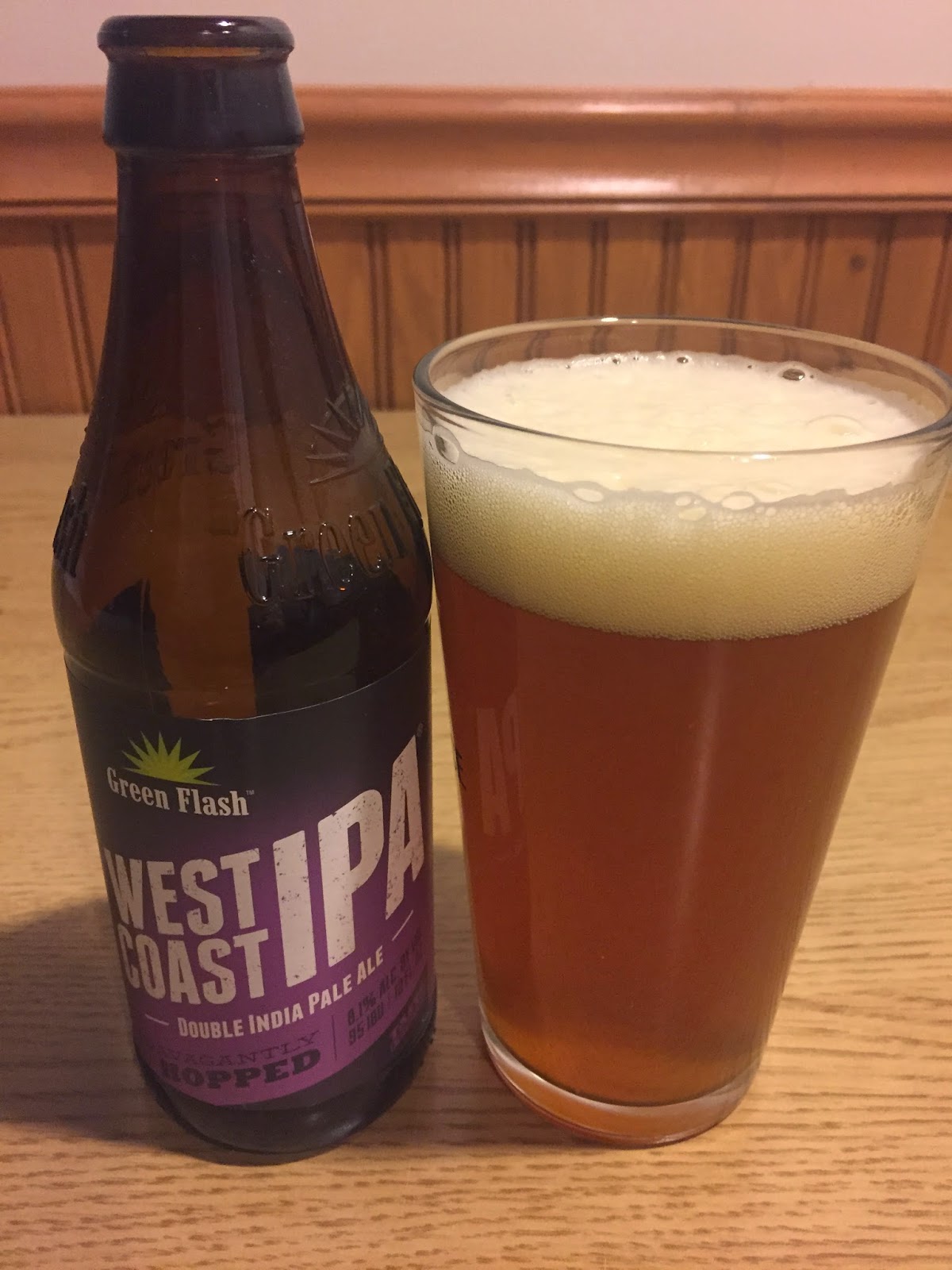
Here is a picture of my West Coast IPA.

Green Flash: West Coast IPA
ABV: 8.1%
Style: American Double / Imperial IPA
Rating: #97 in style

My West Coast IPA poured a orange copper with a bit of haze and a nice stable head.  The smell is a complex aroma of citrus and pine.  The taste is of course extremely flavored with hops.  I do believe my particular West Coast IPA may have been a little aged, as I don't quite get some of the citrus complexity I expected to and I did see a bit of sediment floating around in my glass.  I did get nice hop bite and at 8.1% ABV West Coast IPA is packing a punch.

West Coast IPA is loaded with hops.  The label attests to the variety of hops in this beer:
Simcoe: tropical and grapefruit zest
Columbus: hop pungency
Centennial: pine notes
Citra: citrus zest
Cascade: floral aroma

You'll want to give West Coast IPA a try if you like hoppy beers.  But be certain you are in the mood for hops, because you will get plenty of them in each bottle.


Monday, March 2, 2015

Beer Tasting: Grapefruit Sculpin

Ballast Point Sculpin and Big Eye IPA have been long-time favorites of mine for some time.  These are solid IPAs that you can always go to and expect a great beer.  I heard about a hard-to-find variety called Grapefruit Sculpin.  I missed a keg of Grapefruit Sculpin on tap at The Moor Pat by one day.  The keg was drained in mere hours.  But the timing was right for me to finally have a meeting with this beer at the local Consumer's Beverage beer store yesterday.  One 6-pack of Grapefruit Sculpin was "in the back" and after some gentle prodding and employee infighting I managed to finagle this beer into my possession.  I then went to another location today where I grabbed another two 6-packs directly off the shelf.  Now, with 18 beers, I began to question my purchases and wondered if Grapefruit Sculpin would indeed live up to the hype.

The citrus treasure known as Grapefruit Sculpin does indeed lives up to the hype.

Here's a fact that surprised me.  Did you know that in addition to beer that Ballast Point makes liquor?  In fact, a lot of their spirits have won awards.  Ballast Point makes Three Sheets rum, Fugu vodka, Old Grove gin, and Devil's Share whiskey, to name a few.  Here is a picture of their newest addition, Opah, a herbal liqueur.

Ballast Point is located in San Diego, California.  Did you notice the fishing theme?  And Ballast Point even has their own fishing team!  Here are some pictures of their fishing team and tasting room.


But let's get back to the one fish I really enjoyed, the Grapefruit Sculpin.  Here is a picture of my beer. 

Ballast Point Brewing and Spirits Company: Grapefruit Sculpin
ABV: 7.0%
Style: American IPA
Rating: #18 in style and #244 in top 250 overall

Grapefruit Sculpin pours a clear amber with a modest head.  The smell is certainly citrus up front but not overwhelmingly so.  The taste of Grapefruit Sculpin is really quite amazing, as the hops fight with the citrus for dominance on the palate.  And they both somehow win.  The taste of Grapefruit Sculpin is grapefruit, lemon, and orange at first, and then progresses into the hops you have come to expect from a Sculpin IPA.  The mouthfeel is light with appropriate carbonation.

Oh yeah, and Grapefruit Sculpin is 7.0% ABV.  But because of the citrus, it's impossible to have just one.  You want more because the citrus makes Grapefruit Sculpin just so interesting.  Not complex, mind you.  Just amazingly interesting (there's a joke about a girl I used to know in there somewhere).  Grapefruit Sculpin is different but not overly experimental (see above parenthesis).  The flavors are bold but not overpowering.  Grapefruit Sculpin is a well-crafted balance between hops and front-flavor citrus.

I could imagine drinking Grapefruit Sculpin in my basement in the winter, or on a patio deck in the summer.

NOTE: This beer will be on tap as part of the The Moor Pat Tidal Wave this Wednesday 3/4/15 along with many other Ballast Point beers including Ginger Big Eye IPA, Habanero Sculpin and Victory at Sea Imperial Porter.  If you can't make this event, grab a 6-pack of Grapefruit Sculpin when you can.

Sunday, March 1, 2015

Beer Tasting: Nugget Nectar

Tröegs Nugget Nectar makes a fresh appearance about this time of the year, and I'm always happy to see this Imperial Amber stock the shelves.  For when Nugget Nectar is available, spring is not far behind.  Troeg's brewery was founded by John and Chris Trogner in 1996.  So where does the name Tröegs come from?  The name Tröegs is a combination of a nickname derived from the surname Trogner and the Dutch word kroeg, meaning "pub".  The brewery was founded in 1996 in Harrisburg, PA, and moved to their current location of Hershey, PA, in the fall of 2011.  Tröegs is known for making "scratch" beers, experimental beers that focus on new techniques and non-traditional ingredients.  Here is a picture of their tasting area.


Nugget Nectar is ranked as the #1 overall beer in the category American Amber/Red Ale, and #240 in the top 250 list at Beeradvocate.com.  Nugget Nectar is by far the most popular and most ranked beer by Tröegs at Beeradvocate.com, with 7,429 reviews.  This beer is classified as an Amber/Red Ale, but Nugget Nectar might very well be classified as an IPA.  Nugget Nectar does a fine job blurring the line between IPA and amber, and is packed with flavors, as the logo suggests.


Here is a picture of my Nugget Nectar.

Tröegs Brewing Company: Nugget Nectar
ABV: 7.5%
Style: American Amber/Red Ale
Rating: #1 in style and #240 in top 250 overall

Nugget Nectar pours with a orange color, and a 1-finger tan foam recedes with some substantial lacing left behind.  The smell is sweet amber malt and floral hops.  The taste is sweet on the tongue at first, then packed with hops on the swallow, and followed by a substantial bitterness.  There is also a sweet caramel aftertaste in Nugget Nectar as well.  The carbonation is light and the mouthfeel is medium and resiny.  Weighing in at 7.5%, Nugget Nectar packs quite a punch in alcohol as well, and that ABV can certainly be detected after a few sips.

As the logo suggests, there are quite a bit of hops squeezed into every glass of Nugget Nectar.  The Tröegs web site lists nugget, warrior, tomahawk, simcoe, and palisade hops as ingredients in this cornucopia of lupulin.  You might not guess Nugget Nectar is quite so high in alcohol due to the enormity of flavors present, and the tastes are complex and sophisticated enough to leave you wanting another one.

Nugget Nectar is packed with hops and will certainly help you pass some time through February and March until the arrival of spring.

Wednesday, February 25, 2015

Beer Science: Beta Acids

If you have not read the article on Beer Science: Alpha Acids, you can do so by clicking the link.  In summary, alpha acids are present in lupulin glands present in the cones (strobiles) of mature female hop plants.  But there are other acids and oils that can affect both the flavor and bitterness of beer.  One of the main categories of these other compounds is called beta acids.  This entry seeks to tackle the relative importance of beta acids, especially when compared to alpha acids.

Alpha vs. Beta Acids: What's Different?
Brewers believe that alpha acids are of primary importance to consider when brewing a beer.  Beta acids are only important when considered in context with alpha acids.  Below is a list of some known alpha and beta acids:

Alpha acids:
(1) Humulone
(2) Cohumulone
(3) Adhumulone
(4) Posthumulone
(5) Prehumulone

 Humulone
Beta acids:
(1) Lupulone
(2) Colupulone
(3) Adlupulone


Lupulone

So why do brewers seemingly care more about alpha acids than beta acids when building a beer? Notice that the structures of these compounds are very similar.  But in chemistry even a small difference can result in a significant impact in the characteristics of a compound.

As compared to humulone, the addition of some carbons on the lower part of the lupulone molecule result in beta acids being insoluble.  Alpha acids are soluble in the brewing process and are converted to iso-alpha acids.  Iso-alpha acids content is measured and reported as International Bitterness Units (IBUs).  Beta acids on the other hand are relatively insoluble during brewing and therefore do not contribute much to the perceived bitterness of beer.
 
So Why Care About Beta Acids?
Beta acids comprise a significant percentage of lupulin and hop oils.  In fact, most hops contain just as many beta acids as alpha acids.  The beta acids do not seem important during the brewing process.  However, beta acids isomerize when stored over time.  And when they isomerize, beta acids do contribute to perceived bitterness.  In fact, isomerized beta acids are perceived as being much more bitter than alpha acids (and not in a good way).  Therefore, the ratio of alpha acids to beta acids does seem to matter.  A list of some hop strains and their alpha/beta acids ratio is shown below.

Hop: Alpha/Beta Acids Ratio:
Czech Saaz: 1
Tettnang: 1.3
Hallertauer: 2
Northern Brewer: 2
Chinook: 3.8
Warrior: 3.2
Cascade: 1
Amarillo: 1.5
Simcoe: 2.9

A number higher than 1 indicates that this hop has an equal amount of alpha and beta acids.  A number of 2 indicates twice as much alpha acids as beta acids, etc.  As the beer ages, the alpha acids seem to lose their bittering power, but beta acids bitterness becomes more pronounced over time.  Beta acids seem to produce a harsher and perhaps undesirable hop flavor as they isomerize.


The bottom of this graph shows the relative composition of alpha to beta acids in selected hop strains.  Note that some hops have a much higher degree of alpha acids compared to beta acids.

In summary, The impact of beta acids is perhaps less understood than of the alpha acids.  The importance of beta acids does seem to play a role in the aging of the beer.  But let's be honest- in general, aging is not a desirable trait in beer.  Alpha acids also decompose and oxidize over time.  So beer actually loses bitterness upon aging.  The bitterness of beta acids is harsher than that of alpha acids, and beta acids may in part help beer retain a qualitatively different level of bitterness upon aging.


 References:
The Hop Yard: Alpha and Beta Acids
Love2Brew
Alpha Analytics Hop Profile Chart


  • Humulone
  • Cohumulone
  • Adhumulone
  • Posthumulone
  • Prehumulone
  • - See more at: http://craftbeeracademy.com/the-science-behind-hops-part-1-alpha-and-beta-acids/#sthash.P01HrHdA.dpuf
  • Humulone
  • Cohumulone
  • Adhumulone
  • Posthumulone
  • Prehumulone
  • - See more at: http://craftbeeracademy.com/the-science-behind-hops-part-1-alpha-and-beta-acids/#sthash.P01HrHdA.dpuf

    Sunday, February 22, 2015

    Beer Place: The Moor Pat

    Recently opened The Moor Pat in Williamsville, NY, co-owned by Mike Shatzel and Peter Braun, is one of my favorite beer places... ever.  So it wasn't really a question of IF I should do a review, but WHEN I should do a review.  And last night seemed like the perfect night to call a few friends and head out to Williamsville to see what was on tap.  As always my friends and I were completely satisfied with all aspects of The Moor Pat.


    For those of you that aren't familiar with this cozy beer place called The Moor Pat, a part of me doesn't want you to be.  I want this place all to myself.  I want the classic rock music.  I want the friendly service.  I want the local Spar's sausage and fresh-cut fries.  And I want one of every beer.  Another part of me wants to inform everyone just how great The Moor Pat is.  Silly me, I used to believe that The Moor Pat was a hidden gem.  I believed I could sneak off here on an early evening to have a rare beer in a quiet setting.  But now I realize that may never happen; The Moor Pat is experiencing steady business even at times you wouldn't expect. 

    The Moor Pat does an excellent job at balancing demand and satisfaction.  There aren't many seats, and there is only one room of drinking space.  But you can find a seat if you're patient.  There is a unisex bathroom but never much of a line.  Of average size, the bar area is standing room only most nights. Frequently, the bar is three people deep ordering a beer.  And yet you never have to wait more than a couple minutes to have a full glass of beer in your hand.  There are only two televisions in the bar, but you honesty could care less if they are even turned on.

    All you really care about is what beer you will try next.

    Beers are frequently kicked and new ones tapped.

    The beer board at The Moor Pat is constantly evolving.  Just last night four new beers were tapped during my visit.  There are 20 beers on tap, but it feels like many more.  There is a great mix of kolsch, pale ale, IPA, farmhouse, stout, gose and foreign imports.  Based on my observations, I would say the taps undergo a complete turnover about every 10-14 days.  Even during the busiest time in the evening, when a keg is kicked a replacement beer is immediately tapped.  Last night people watched in anticipation and excitement as Shaun entered the names of newly tapped beers.  In fact, since my departure last night, two new beers have already been tapped.

     Sugar Shaun pens a replacement beer.

    My night at The Moor Pat started with a Ballast Point Grunion, an excellent American pale ale.  I then tried the Stone Enjoy By 3.14.15, a beer that is purposefully fresh.

     Ballast Point Grunion.

      Jacquelyn delivers my Stone Enjoy By with pleasant panache.

    The Moor Pat always has a few rare bottles on-hand as well.  My friends ordered a bottle of the Brewfist Burocracy IPA from Italy.  Of course Shaun delivered the bottle right to our table.

     Shaun delivers a Brewfist Burocracy IPA to our table.

    Brewfist Burocracy from Italy.

    An intermission to the bathroom revealed a sticky note parade.  People can write notes with funny phrases and post them anywhere in the bathroom they wish.

    Bathroom sticky note musings.

    I then tried another great beer, AleSmith Brewing's My Bloody Valentine.  This beer had an awesome roasty smell and a distinctive amber roast taste.  I would grant this beer the award for "most unique" on the beer board for the night.

    AleSmith's My Bloody Valentine.
     
    Along with the beer selection, the music selection at The Moor Pat gets an all-star rating.  Classic rock favorites such as Rolling Stones, Paul Simon, and Black Crowes encourage lengthy beer sessions and spirited conversation.  Amazingly, two bartenders manage to serve the entire crowd with alacrity.  Cozy accommodations coupled with excellent service and ambiance make The Moor Pat a premiere craft beer lover destination.  The Moor Pat also offers scotch, whiskey, and bourbon selections.

     My friends Susan and Diane enjoying their night at The Pat.

    Williamsville residents Mike and Laura, and myself, are satisfied with our beers.

    Even on the coldest of February nights and the most treacherous of traveling conditions, The Moor Pat was packed.  I can only imagine how busy The Moor Pat will be in the summer!  The Moor Pat plans to open a beer garden to satisfy summer thirst.

    The Moor Pat is a master of supply and demand, leaving you fearful you might miss a rare beer if you don't visit often.  Sounds to me like the solution is to visit often.  You'll be glad you did.


    The Moor Pat
    78 East Spring St.
    Williamsville, NY
    http://moorpat.com/